Department
B.Sc. in Anesthesia Technology and Operations Technology
Academic Programmes
DEPARTMENT OF ANAESTHESIA AND OPERATION THEATRE TECHNOLOGY
Academic programs in Anaesthesia and Operation Theatre Technology play an essential role in developing skilled healthcare professionals who contribute to safe anaesthesia practices, efficient surgical services and quality patient care. By providing students with sound theoretical knowledge, practical training and clinical exposure, the program prepares graduates to work effectively in operation theatres, anaesthesia departments, intensive care units and emergency care settings.
Programs Offered by the Department
Undergraduate Programs
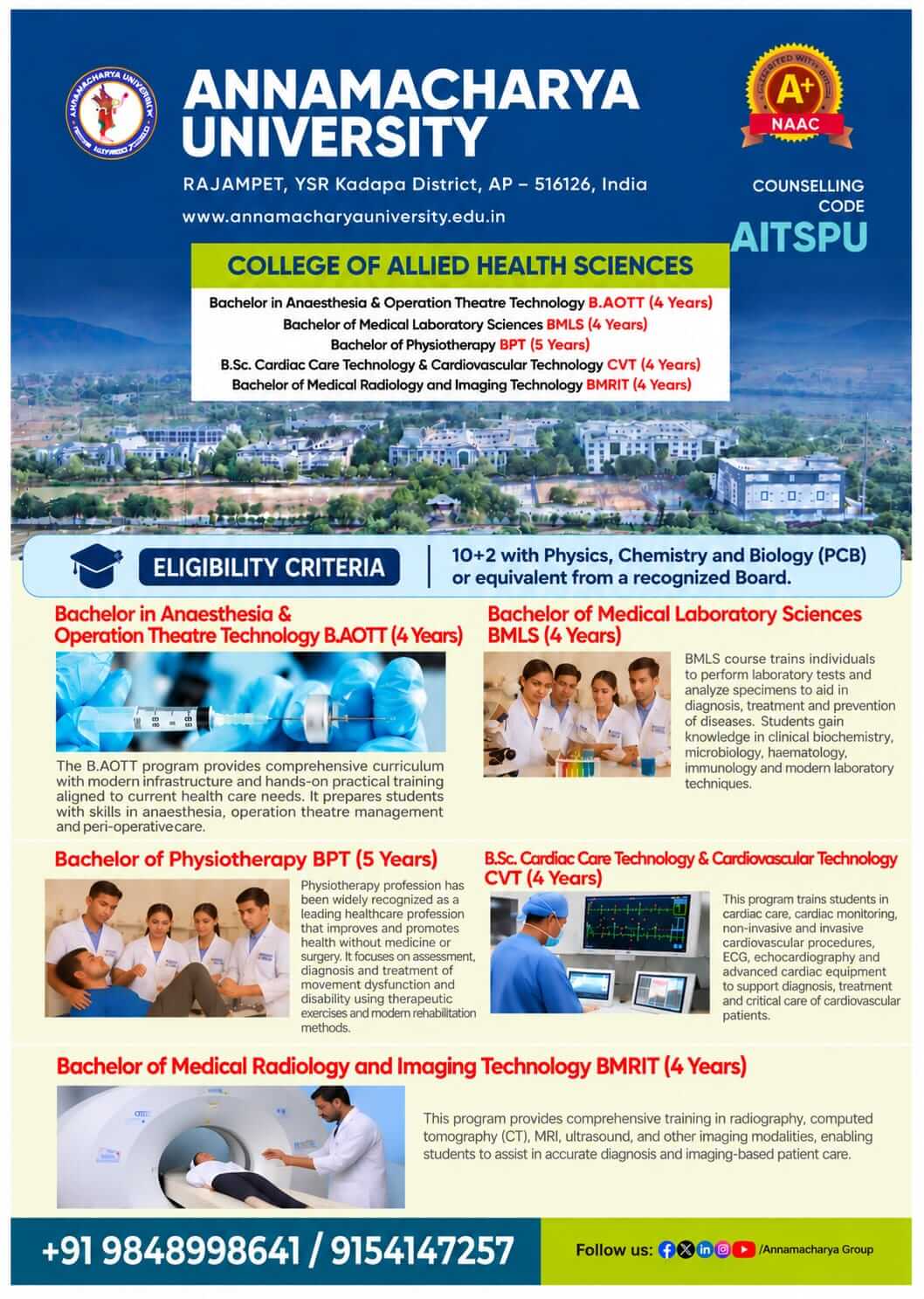
Bachelor in Anaesthesia and Operation Theatre Technology (B.AOTT)
The Department of Anaesthesia and Operation Theatre Technology at Annamacharya University, Rajampet, offers an undergraduate program was started in 2024, with an intake of 39 students and increased to 60 students subsequently and is designed to develop competent and skilled professionals in anaesthesia technology, operation theatre management and perioperative patient care.
The department is headed by qualified faculty members who monitor academic activities, clinical training, student development and departmental activities.
Duration
- 4 years (8 semesters)
- Each semester usually lasts 5-6 months, including examinations.
Credit Requirements
The total credit requirements for the undergraduate program are 160 and the curriculum generally consists of the following components:
1. Foundation Courses
Typically contribute to 20% of the total credits.
- Human Anatomy and Physiology.
- Biochemistry and Biochemistry-related fundamentals.
- Pathology and Microbiology.
- Basic Pharmacology.
- Basic medical sciences and allied healthcare subjects.
- Communication skills, professional ethics and healthcare-related subjects.
2. Core Professional Subjects
Typically contribute to 55% of the total credits.
- Advanced Surgical Procedures.
- Basics in Surgical Procedures.
- Clinical medicine and it’s relative management.
- Basic Intensive Care.
- Advanced Anaesthesia Techniques.
- Specialized Anaesthesia.
- Specialized Surgery.
- Specialized Anaesthesia and Surgery.
3. Clinical Training and Internships
Typically contribute to 15% of the total credits.
- Clinical postings in operation theatres and anaesthesia departments.
- Exposure to general, regional and other anaesthesia techniques.
- Training in patient monitoring and anaesthesia equipment handling.
- Clinical exposure in intensive care units (ICUs), emergency departments and recovery rooms.
- Supervised internship to develop professional skills and clinical competencies.
4. Elective and Skill Enhancement Courses
- Skill-based and competency-oriented learning activities.
- Simulation-based training and clinical skill development.
- Research methodology and evidence-based healthcare practices.
- Emerging technologies and advancements in anaesthesia and surgical care.
- Interdisciplinary learning and professional development activities.
5. Mandatory Non-Core Courses
Typically contribute to 10% of the total credits.
- Medical Law, Professional ethics and healthcare values.
- Disaster Management and Environmental studies.
- English,Communication and interpersonal skills.
- Research Methodology and Bio statistics
- Basic life support and patient safety awareness.
Clinical and Laboratory Facilities
The department focuses on providing practical learning opportunities through laboratory demonstrations, equipment handling sessions and simulation-based training.
The major areas of practical exposure include:
- Anaesthesia workstations and breathing systems.
- Patient monitoring equipment, including ECG, SpO₂, NIBP and EtCO₂.
- Mechanical ventilators and airway management equipment.
- Laryngoscopes, endotracheal tubes and supraglottic airway devices.
- Anaesthesia instruments and accessories.
- Surgical instruments and operation theatre equipment.
- Sterilization and infection prevention practices.
- Basic life support and emergency resuscitation equipment.
- Simulation-based clinical skill training.
Clinical Training Facilities
Students receive supervised clinical exposure in relevant healthcare departments, at the hospitals collabarated including:
- Operation Theatre Complex.
- General Anaesthesia and Regional Anaesthesia Units.
- Intensive Care Units (ICUs).
- Post-Anaesthesia Care Unit (PACU).
- Emergency and Casualty Departments.
- Specialized Surgical Departments.
These clinical experiences help students develop technical competency, teamwork, communication skills and professional confidence.
Accreditation and Regulatory Compliance
- The Anaesthesia and Operation theatre Technology department successfully underwent peer review and on-site evaluations in early 2026.
- Accreditation granted in October 2026, indicates compliance with criteria such as infrastructure, faculty qualifications, curriculum and student achievements.
- It assures stakeholders (students, parents, employers) that the program adheres to globally benchmarked standards.
- The program aims to align with the relevant provisions of the National Commission for Allied and Healthcare Professions (NCAHP) Act, 2021, and applicable university and regulatory requirements.