Skill Development Center (SDC)
The Skill Development Center (SDC) at Annamacharya University was established in collaboration with the Andhra Pradesh State Skill Development Corporation (APSSDC) and Siemens to provide industry-oriented technical training to students. The center offers practical education through specialised laboratories: the CNC Laboratory, Automotive Servicing Laboratories (Four-Wheeler and Two-Wheeler), Agro-Machinery Laboratory, and Welding Laboratory. These labs are equipped with modern machinery and simulation tools, giving students exposure to current industrial technologies.
The primary objective of the SDC is to bridge the gap between academic knowledge and industrial practice by equipping students with hands-on technical skills and the professional competencies needed to solve real industrial problems.
Aligned with the National Education Policy (NEP) 2020, the SDC promotes experiential, competency-based, and multidisciplinary learning. Students take part in real-time projects, technical workshops, industrial demonstrations, and simulation-based training. The center integrates vocational education with conventional academic programmes, so students can earn industry-recognised skill certifications alongside their regular degrees. This supports NEP 2020’s emphasis on flexible learning pathways, skill integration, and multiple entry and exit options.
Training Levels
The APSSDC-Siemens Skill Development Programme adopts a structured, tiered pedagogical framework to accommodate students with different academic backgrounds, technical competencies, and levels of industrial exposure. The framework ensures systematic skill development, progressing from fundamental industrial safety and basic technical knowledge to advanced industry specialization and research-oriented capstone projects.
The programme is organized into four progressive levels, namely Foundation (Level A), Expert (Level B), Master (Level C), and Capstone Project and Industry Integration (Level D). Each level is designed to address specific learning requirements and prepare students for the next stage of technical and professional development.
Level A: Foundation Level – Baseline Skills and Industrial Safety
The Foundation Level is designed for first- and second-year B.Tech students, polytechnic diploma students, and ITI trainees. The primary emphasis is on developing essential technical knowledge, industrial awareness, and basic operational competencies.
The training modules cover:
- Fundamental engineering and applied technical concepts.
- Basic industrial safety procedures and laboratory practices.
- Introduction to tools, machinery, and equipment handling.
- Basic equipment operation and maintenance practices.
- Engineering drawing interpretation and blueprint reading.
- Introduction to manufacturing processes and workshop practices.
This level establishes the fundamental technical knowledge and practical skills required for advanced domain-specific training.
Level B: Expert Level – Domain-Specific Core Training
The Expert Level targets third-year B.Tech students and advanced diploma students. It focuses on developing intermediate-level technical competencies through domain-specific applied engineering and industrial training.
The major areas of training include:
- Intermediate automation and industrial control systems.
- Programmable Logic Controller (PLC) programming and applications.
- Advanced CNC machine operation and manufacturing processes.
- Electrical and electronic circuit diagnostics.
- Industrial equipment operation and troubleshooting.
- Practical applications of engineering principles in manufacturing and automation.
This level enables students to strengthen their technical problem-solving abilities and gain practical exposure to industrial processes and equipment.
Level C: Master Level – Advanced Industry Specialization
The Master Level is primarily designed for final-year B.Tech students and provides specialized technical training through a structured programme of 150 instructional hours, comprising 70 hours of classroom-based theoretical instruction and 80 hours of intensive practical project work.
The curriculum emphasizes advanced industrial applications, specialized engineering tools, and project-oriented learning. Major training areas include:
- Digital manufacturing and advanced production technologies.
- Dynamic system analysis and industrial applications.
- Advanced Finite Element Modelling (FEM).
- Industrial process optimization and analysis.
- Advanced engineering simulation and design applications.
- Practical project development based on industry requirements.
The combination of theoretical instruction and intensive practical training enables students to apply advanced engineering concepts to industrial problems and develop specialized technical competencies.
Level D: Capstone Project and Industry Integration
The Capstone Integration Level is designed for eighth-semester B.Tech students and connects their final-year academic projects with industry-oriented Project-Based Learning (PBL). This level emphasizes the practical application of knowledge acquired through the previous training levels.
The key features include:
- Selection and development of industry-relevant capstone projects.
- Joint academic and industry mentorship.
- Project guidance and technical support from institutional faculty and industry experts associated with Siemens and DesignTech networks.
- Application of advanced engineering tools, simulation software, and industrial technologies.
- Development of innovative solutions to real-world industrial problems.
- Project demonstrations, technical evaluation, and outcome-based assessment.
Successful completion of Level D projects provides students with opportunities to strengthen their professional portfolios and supports pathways towards industrial internships, industry collaborations, and placement opportunities in manufacturing and technology sectors.
Objectives and Outcomes
A) Goals and Objectives of the Skill Development Center
The major goals and objectives of the Skill Development Center are as follows:
- Industry-Relevant Skill Development: To provide students with practical, industry-oriented technical skills through modern laboratory facilities, advanced machinery, and simulation-based training.
- Enhancement of Employability: To improve students’ employment prospects through hands-on training, technical proficiency, industrial exposure, and professional competency development.
- Entrepreneurship and Innovation: To encourage creativity, innovation, independent problem-solving, and entrepreneurial thinking by motivating students to develop practical solutions and start-up ideas.
- Critical Thinking and Professional Development: To develop critical thinking, teamwork, communication, leadership, and ethical professional practices among students.
- Industry-Academia Collaboration: To strengthen collaboration between academic institutions and industries through expert interactions, technical workshops, industrial projects, and joint mentoring activities.
- Preparation for Emerging Industrial Technologies: To develop a skilled and adaptable workforce capable of responding to technological advancements and changing requirements in manufacturing, automotive, automation, and fabrication sectors.
- Lifelong Learning and Continuous Development: To encourage continuous learning, upskilling, and reskilling so that students can remain competent and updated throughout their professional careers.
- Integration of Academic and Vocational Education: To promote competency-based learning by integrating vocational training and industry-recognized certifications with conventional academic programmes in accordance with NEP 2020.
B) Expected Outcomes and Impact
The Skill Development Center is expected to create a strong foundation for industry-ready engineering graduates by integrating academic instruction with practical and competency-based technical education. Through the progressive Levels A–D training framework, students acquire fundamental, intermediate, advanced, and project-based industrial competencies according to their academic progression.
The programme is expected to contribute to:
- Improved practical knowledge and technical proficiency among students.
- Enhanced employability and readiness for industrial careers.
- Increased participation in industry-sponsored projects and internships.
- Development of innovative solutions and entrepreneurial initiatives.
- Strengthened collaboration between the university, APSSDC, Siemens, and industry partners.
- Greater exposure to advanced manufacturing, automation, automotive servicing, and fabrication technologies.
- Recognition of students’ technical competencies through structured skill development and certification pathways.
Through these initiatives, the Skill Development Center at Annamacharya University contributes to the objectives of NEP 2020, strengthens industry-academia partnerships, and supports the development of a technically competent, innovative, and future-ready workforce. Ultimately, the center aims to enhance individual career opportunities while contributing to industrial growth and national economic development.
Laboratories
AGRO-MACHINERY LAB
Objectives:
- Train students in the operation and maintenance of agro-machinery.
- Teach the working principles of tractors, irrigation systems, and seed drills.
- Develop practical skills in water, soil testing, and irrigation system setup.
Description:
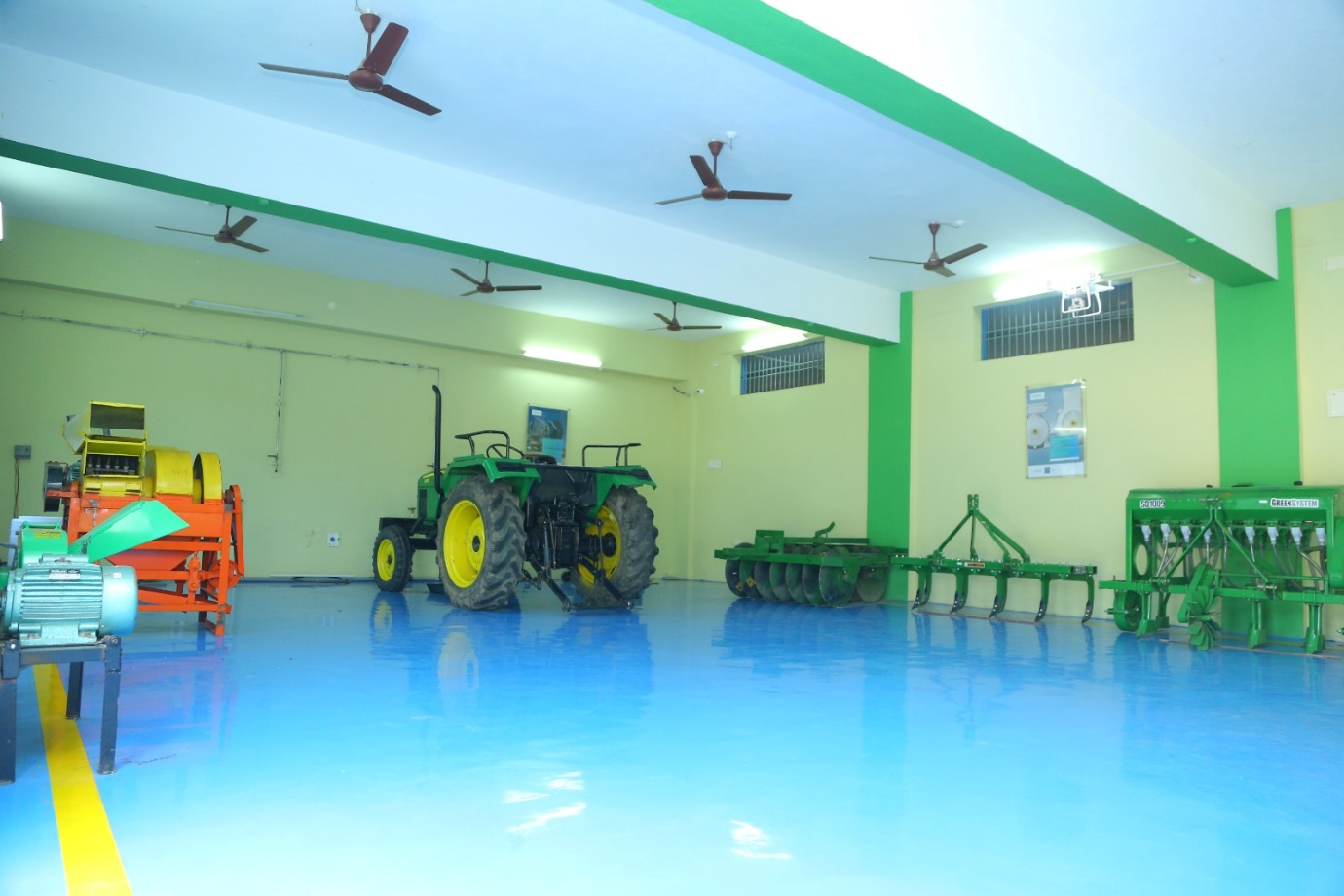
The Agro-Machinery Lab provides students with practical and theoretical knowledge of various agricultural machines used in farming. The lab focuses on equipment for soil preparation, seed planting, inter-cultivation, plant protection, harvesting, and threshing. It features a range of machinery, including tractor-operated, power tiller-operated, self-propelled, stationary engine-operated, and manually operated tools. Practical sessions involve hands-on experience with real farm machinery to develop technical skills. Additionally, the lab includes cut-section models of different machines, which help students clearly understand the internal components and working mechanisms of various agricultural systems, enhancing their learning and technical understanding.
Key Areas Covered:
- Tractor servicing at foundation level, (which includes engine, air intake system, lubrication system, cooling system and many more)
- Irrigation equipment (Maintenance and Field Operation)
- Seed Drill (Maintenance and Field Operation).
- Water testing & Soil testing
- Demonstration of Solar water pumping system
- Demonstration of fuel-injection system on a engine cut section model
- Performance of offset disc harrow
- Performance of primary tillage implements
- Study of Internal combustion Engine components
- Study Air cooling system and its advantages
- Experiments to test Water and Soil Testing
- Study of Drip and sprinkler Irrigation system
List of Equipment Available:
- Tractor
- Drip Irrigation system
- Sprinkler Irrigation system
- Cultivator
- Disc-Cultivator
- Seed Drill Threshing Equipment’s
- Multi crop thresher
- Chara-cutter
- Solar panel pumps
- Submersible pumps
- Centrifugal pumps
- Generator
- Water Testing Kit
- Soil Testing Kit
- Air Compressor
- Tractor Engine cut-section
Outcomes:
- Perform basic servicing of tractors and irrigation equipment.
- Identify and maintain key components of agro-machinery.
- Conduct field experiments related to soil, water, and irrigation systems.
Automotive 4-Wheeler and 2-Wheeler Laboratory
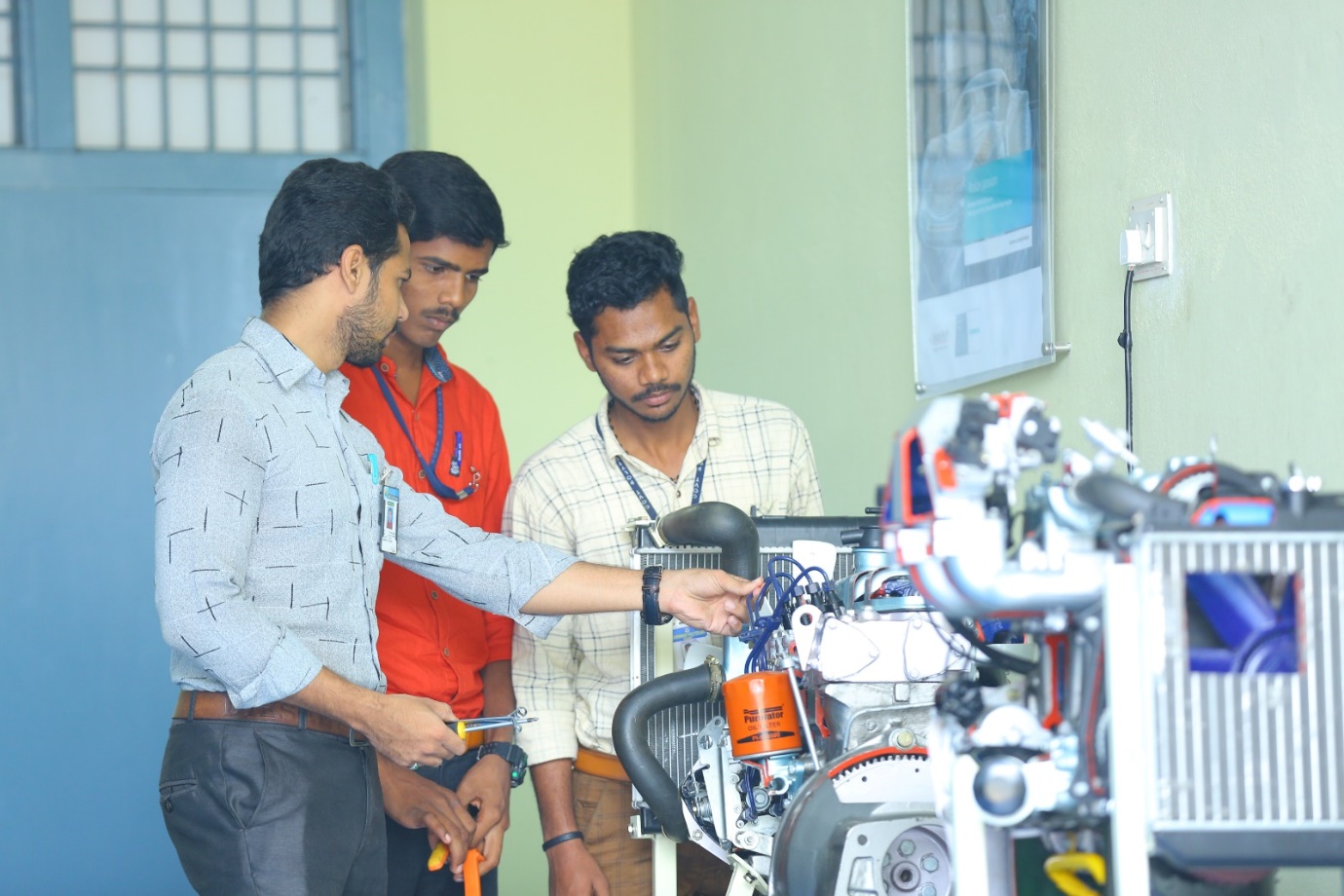
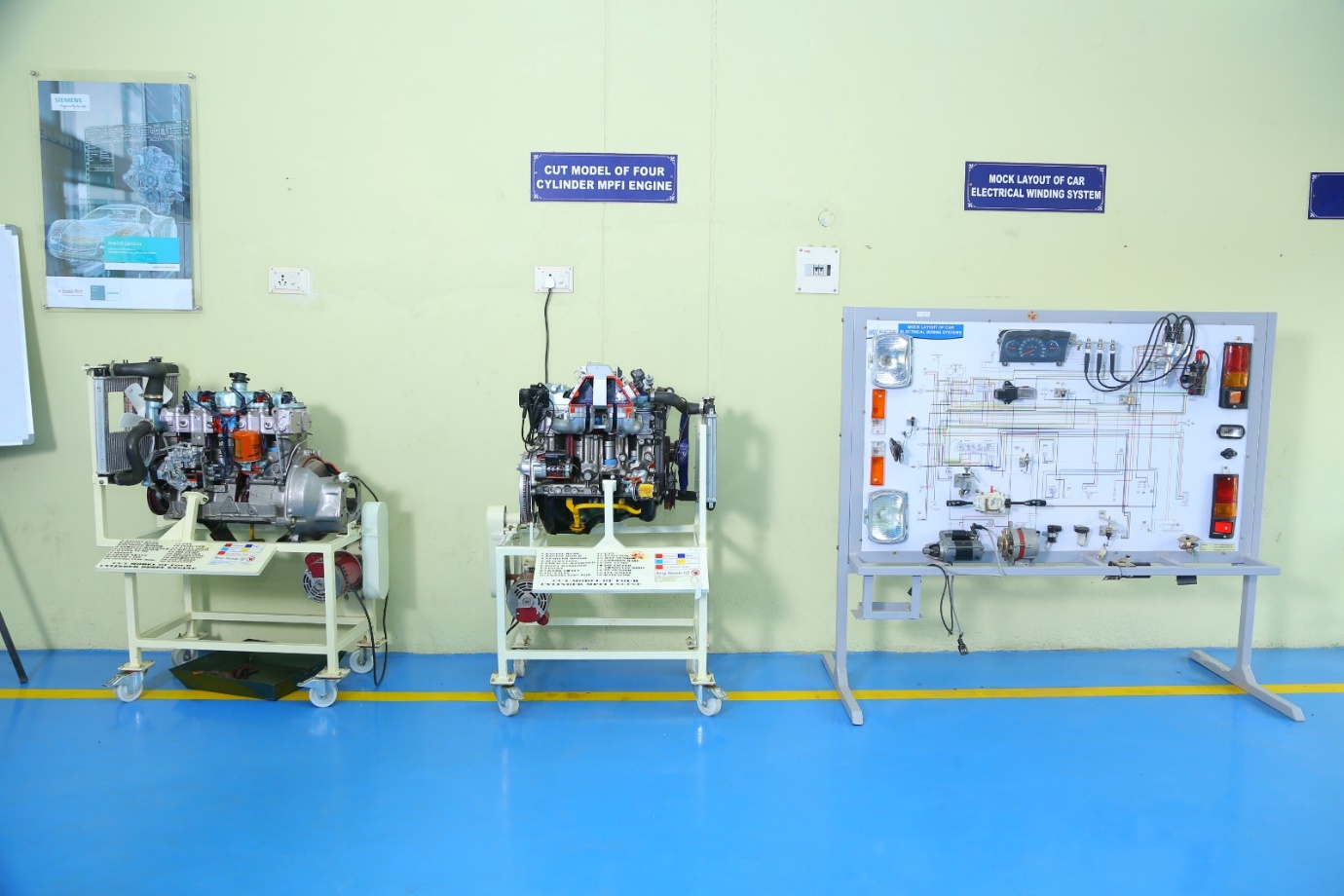
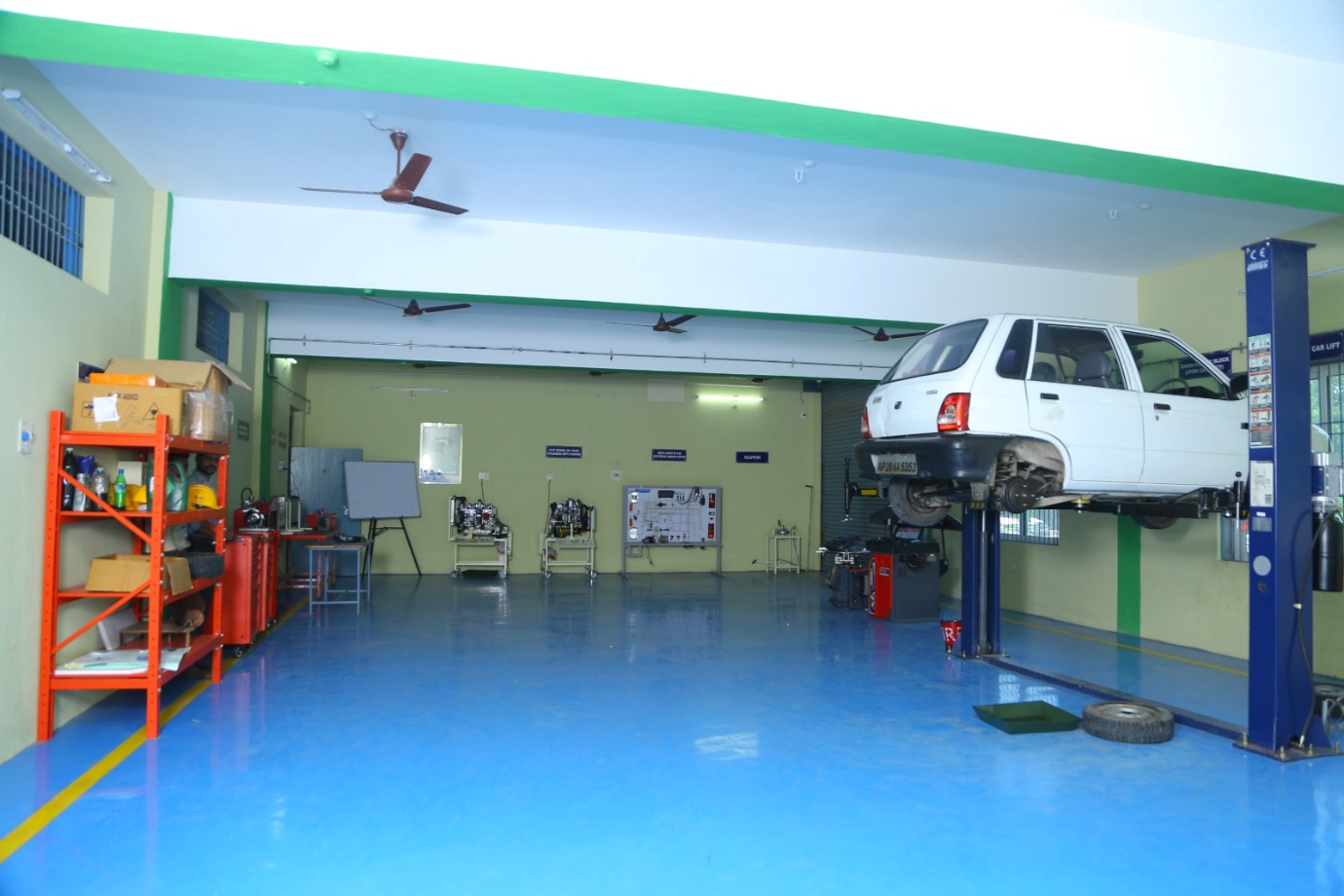
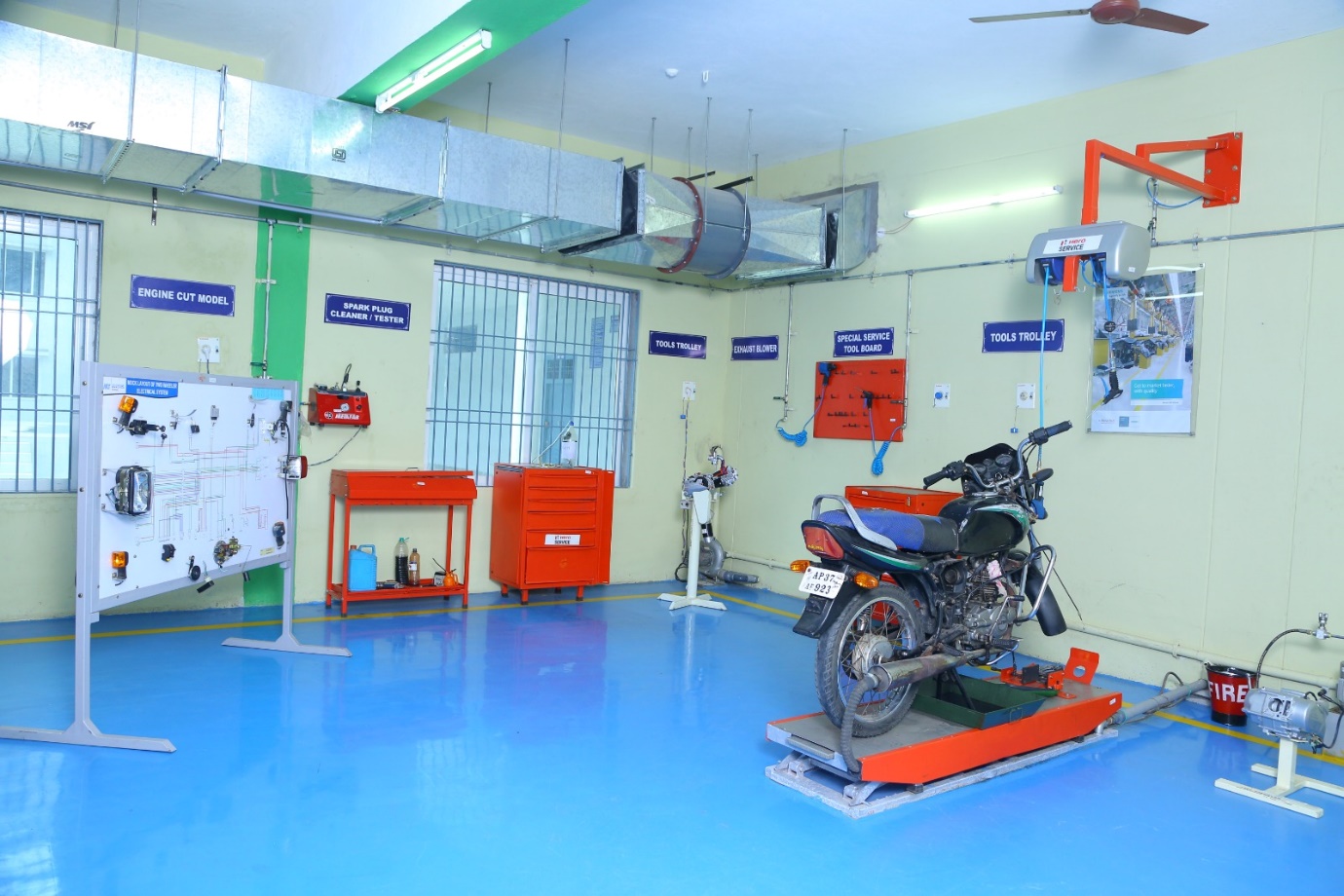
Objectives:
- Provide hands-on experience in vehicle maintenance and diagnostics.
- Teach dismantling, assembling, and servicing of automotive systems.
- Familiarize students with modern automotive technologies.
Description:
The Automotive Laboratory offers practical training in essential vehicle maintenance and repair techniques. The course begins with safety procedures, followed by an introduction to 4 and 2-wheeler automobiles and workshop equipment. Students learn basic automotive servicing, repair, and overhauling, along with skills in diagnosing and repairing automobile electrical systems. The program also covers the repair of auto air conditioning systems and regular engine system maintenance. In-depth training is provided in engine overhauling for both petrol and diesel engines. Additionally, students gain experience in the repair and maintenance of transmission systems, preparing them for various roles in the automotive service industry.
Key Areas Covered:
- Safety and precautions
- Introduction to Auto 4 & 2-Wheeler and equipment
- Auto 4 & 2-Wheeler servicing at foundation level, (which includes engine, air intake system, lubrication system, cooling system and many more)
- Study of Internal combustion Engine components
- Study Air- and water-cooling system and its advantages
- Automobile Electrical System
- Basic Automotive Servicing, Repair, and Overhauling
- Demonstration of fuel-injection system on a engine cut section model
- Transmission System Repair and Maintenance
List of Equipment Available:
- Cut Section of Engine and Other Vehicles Aggregates Like Rear Axle Assembly
- Diesel Engine with Clutch and Gear Boxes 6 Cylinder
- Driving Range for Basic Practice & Steering Control
- Two Post Lift
- Electrical System
- Engine With Clutch
- Fuel System
- Gear Box
- Battery Charging cum tester
- Diagnostic Tool/scanner
- Oil Draining & Filling Equipment
- sparkplug cleaner
- Fuel injection pump test bench with accessories
- Wheel Balancer
Outcomes:
- Diagnose and troubleshoot common vehicle problems.
- Perform routine servicing of 2-wheelers and 4-wheelers.
- Use diagnostic tools for checking engine and electronic systems.
Level C: Master Level – Advanced Industry Specialization
Objectives:
- Provide training in Arc Welding, Gas Welding, TIG, and MIG welding.
- Understand welding symbols, joint design, and inspection techniques.
- Develop safety practices related to welding.
Description:
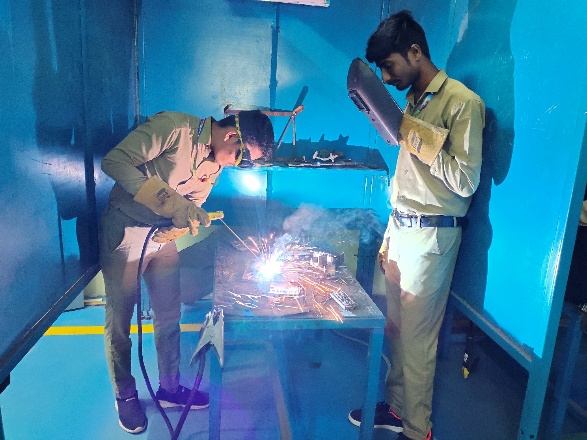
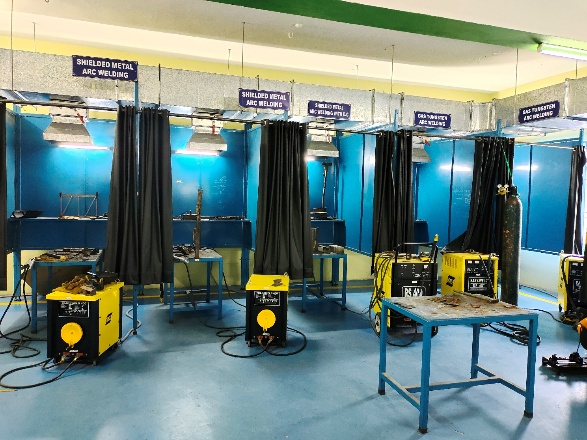
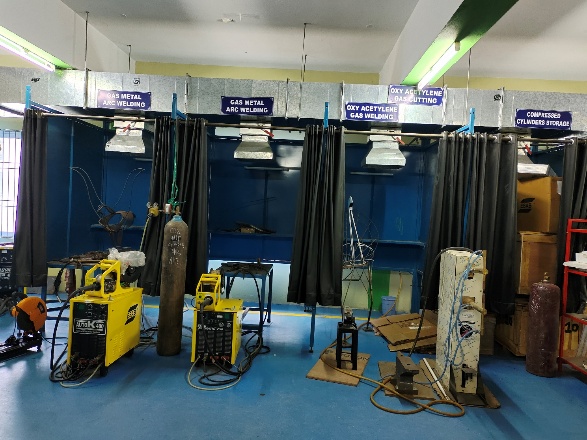
The Welding course is designed to provide students with a strong foundation in both the theoretical and practical aspects of welding. It introduces students to the welding industry and prepares them to handle real-world welding tasks. The program focuses on helping students master various welding techniques, with training aligned to the standards of the American Welding Society (AWS) for a Level I entry-level welder. As part of the course, students gain hands-on experience in the Welding Laboratory, which is set up to simulate industrial welding environments. The lab is fully equipped with modern tools and machines that allow students to practice different welding and cutting processes. These include oxy-fuel welding, shielded metal arc welding (SMAW), gas tungsten arc welding (GTAW), gas metal arc welding (GMAW), resistance spot welding, and oxygen cutting. By the end of the course, students will have developed the essential skills and knowledge needed to start a career in welding or pursue further specialization in the field.
Key Areas Covered:
- Welding safety and precautions
- Introduction to welding tools and equipment
- ARC Welding-AC
- ARC Welding-DC
- TIG Welding
- MIG Welding
- Oxy Acetylene Gas Welding
- Oxy Acetylene Gas Cutting
List of Equipment Available:
- Auto K-400
- Easyweld 400-T
- RS 400, Migmatic 250
- Transweld
- Gas welding
- Gas Cutting equipment
- Safety equipment and tools
Outcomes:
- Perform different types of welding with industry-standard quality.
- Inspect weld joints for defects and perform corrective measures.
- Apply welding skills in real-time fabrication projects.
MANUFACTURING- CNC LAB
Objectives:
- Train students in CNC programming, simulation, and operation.
- Develop skills in tool path generation and part production.
- Understand CNC machining principles and industrial applications.
Description:
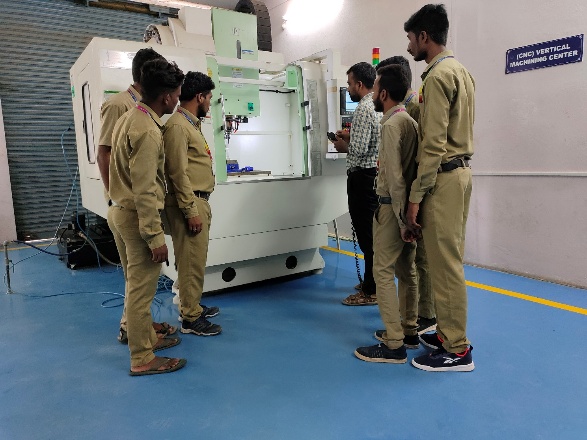
The Computer Numerical Control (CNC) Laboratory is equipped with advanced machines and simulation tools to provide hands-on learning experiences. The lab includes an LMW VJ 55 Vertical Machining Centre (VMC), SMARTURN CNC lathe, and Siemens Simulation controllers for programming practice. The primary objective of the CNC lab is to help students develop practical skills in operating and programming CNC machines. This training enhances their understanding of modern manufacturing processes. The laboratory plays a key role in preparing mechanical engineering students for advanced studies and professional careers in the manufacturing sector, where CNC technology is widely used.
Key Areas Covered:
- Computer-aided manufacturing (CAM) (Manufacturing)
- POD software for online demonstration of CNC lab through tutorials
Software Used:
- SINU TRAIN for Sinumeric operate
- NX CAM
- SINUMERIC 8400SL
- SINUMERIC 828D/828D
Basic training simulation modules.
List of Machinery Available:
- Model Smart turn CNC lathe
- JV55 vertical machining center
- Siemens simulation controllers
Outcomes:
- Ability to write and simulate CNC programs.
- Operate CNC Lathe and Milling Machines safely and efficiently.
- Understand manufacturing tolerances and surface finish requirements.
Training Utilization
The Skill Development Center laboratories have been used for skill training continuously since 2017. Up to 06-12-2022, 4,623 students were trained in 223 batches across seven training areas. From 2023-24 to 2025-26, another 302 students were trained, which brings the total to 4,925 students. In addition, 42 faculty members were trained in five Faculty Development Programme (FDP) batches.
| S.No. | Training Area | Up to 06-12-2022 | 2023-24 to 2025-26 | Total Students |
|---|---|---|---|---|
| 1 | Auto (4 Wheeler) | 1,166 | 158 | 1,324 |
| 2 | Solid Edge (design) | 1,141 | – | 1,141 |
| 3 | Welding | 1,007 | – | 1,007 |
| 4 | Auto (2 Wheeler) | 625 | – | 625 |
| 5 | CNC Turning | 460 | 144 | 604 |
| 6 | Computer and IT Fundamentals | 121 | – | 121 |
| 7 | Agro-Machinery | 74 | – | 74 |
| 8 | CNC Milling | 29 | – | 29 |
| Total | 4,623 | 302 | 4,925 | |
| S.No. | Year | Students Trained |
|---|---|---|
| 1 | 2017-18 | 306 |
| 2 | 2018-19 | 1,371 |
| 3 | 2019-20 | 1,264 |
| 4 | 2020-21 | 306 |
| 5 | 2021-22 | 782 |
| 6 | 2022-23 (up to 06-12-2022) | 594 |
| 7 | 2023-24 | 110 |
| 8 | 2024-25 | 104 |
| 9 | 2025-26 | 88 |
- Peak Use: 2018-19 and 2019-20 had the highest numbers, with 1,371 and 1,264 students.
- Hosting and Outside Students: Up to 06-12-2022, 61% of students (2,840) were from the hosting institute and 39% (1,783) came from outside institutes. Outside participation was recorded in 2018-19 and 2019-20.
- Most Used Labs: Auto (4 Wheeler), Solid Edge, and Welding each trained more than 1,000 students.
- Batch Size: The average batch had about 21 students.
- Who Used the Labs: Batch records from November 2017 to March 2020 show 2,920 students in 164 batches. They came from engineering colleges (1,102 students), polytechnics (548), ITIs (274), intermediate vocational colleges (231), welfare institutions (346), and others. 29 outside institutions took part, and 57 batches (327 students) were internship programmes.
- FDP: 33 ITI faculty (one welding and three CNC turning batches) and 9 polytechnic faculty (one welding batch) were trained.
General Policies of the Skill Development Center
- Eligibility and Enrolment: Training is open to students at the level that matches their academic stage. Enrolment is through the Skill Development Center.
- Attendance: Students must attend theory and practical sessions regularly. Attendance is considered for assessment and certification.
- Safety First: Students must wear the prescribed protective equipment and follow all safety instructions in the laboratories.
- Use of Machines and Equipment: Machines and equipment may be operated only under the supervision of the instructor. Any fault or damage must be reported immediately.
- Discipline and Conduct: Students must maintain discipline, respect instructors and fellow students, and follow professional and ethical practices.
- Cleanliness and Housekeeping: Students must keep the laboratories clean and return tools and materials to their places after use.
- Laboratory Timings: Laboratory access and training schedules are set by the Skill Development Center.
- Assessment and Certification: Students are assessed as per the programme guidelines. Certificates are issued on successful completion, following the norms of the certifying partners.
- Projects and Industry Activities: Students must follow the guidelines of the Skill Development Center and industry mentors during projects, workshops, and demonstrations.
- Revision of Policies: The Skill Development Center may update these policies when needed.

Dr. B. Venkatesh
In-charge, APSSDC and Siemens Skill Development Laboratories
Associate Professor, Department of Mechanical Engineering
Annamacharya Institute of Technology & Sciences, Rajampet.
Laboratory In-charges
| S.No. | Laboratory | In-charge |
|---|---|---|
| 1 | Manufacturing – CNC Lab | Mr. V. Venkatesh |
| 2 | Automotive Laboratory – 4-Wheeler | Dr. B. Venkatesh |
| 3 | Automotive Laboratory – 2-Wheeler | Mr. S. Nagendra |
| 4 | Manufacturing – Welding Lab | Mr. G. Eswar Balachandar |
| 5 | Agro-Machinery Lab | Dr. B. Venkatesh |